Prometheus at Starbase
Why Europe stopped looking up, and how to start again
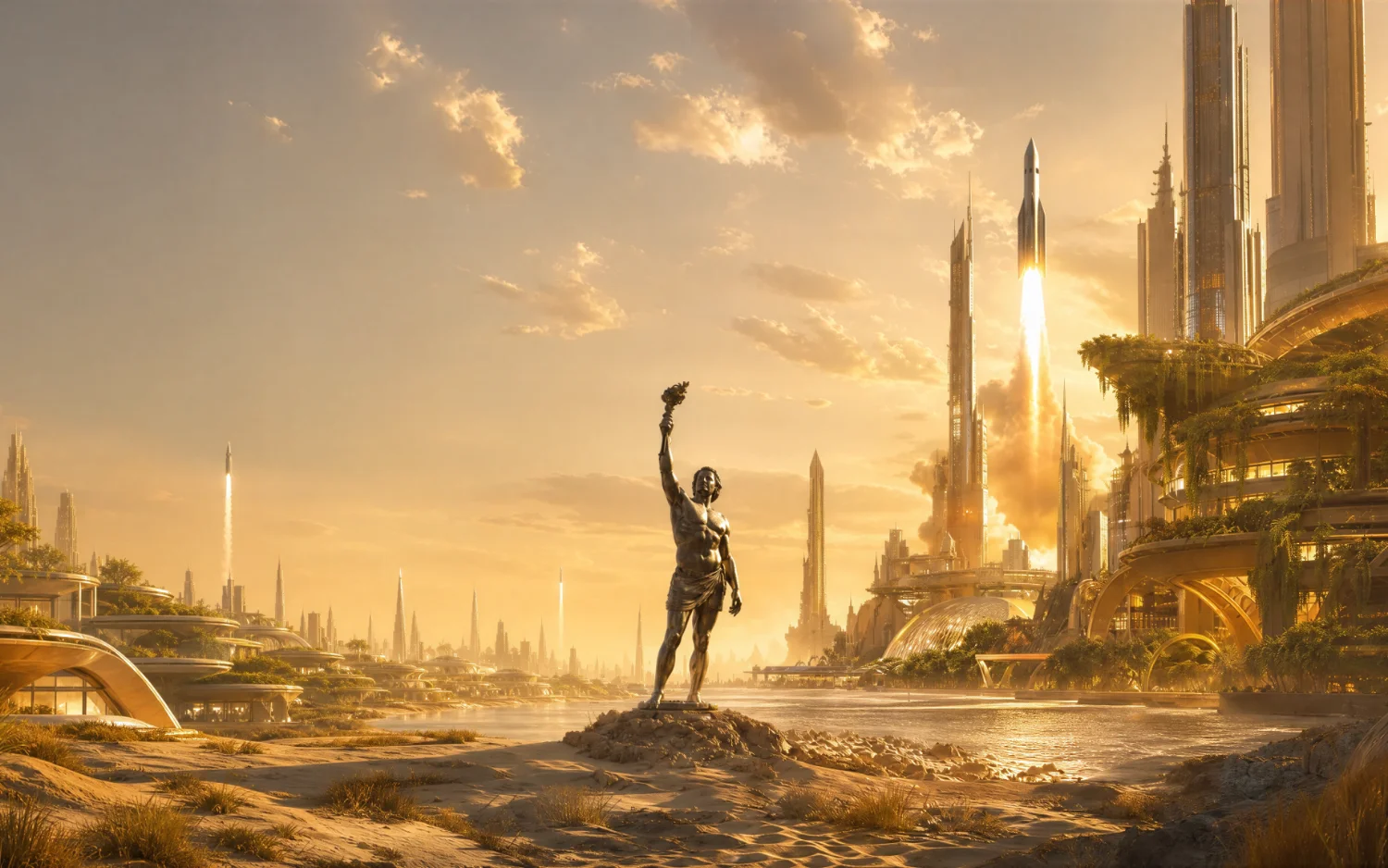
I remember the awe. I was 12; it was 1990, and the future arrived in a children’s magazine—advertised in Mickey Mouse, ordered as a mail-in for 29,95 DM: a Dick Tracy watch. It was a plastic replica with a fake leather band. The watch might even have worked, and it looked like the real one. Pressing the button made Dick Tracy speak. You couldn’t talk to anybody.
I didn’t care. I wore it like a key to another world, because I saw a glimpse of the future in it: a world where you could talk to anyone, anywhere, from your wrist. This was long before mobile phones.
Then came the books. I read Isaac Asimov’s robot and empire novels from I, Robot to Foundation and Earth. I followed R. Daneel Olivaw, the robot who outlives empires and guides humanity through millennia, and I believed—the way only a child can believe—that I would live to see machines that think, ships that land on their tails, and cars that talk back.
I was right. The promise was kept, item by item, on schedule.
And almost nobody noticed.
The future arrived on schedule
Let me go through my childhood list.
The Dick Tracy watch is now an Apple Watch. It has a microphone that works, a display, a phone, a heart-rate sensor, and it costs less than a decent pair of shoes.
Asimov’s positronic brain is now my colleague. All my work is done by agentic AI—and done better. I learned development for 25 years, and now artificial intelligence can do it better than I can. I don’t say this with bitterness. I say it with the same awe I felt as a child holding a plastic watch.
The Moon lander of my picture books now lands on its own. On 5 September 2025, a Falcon 9 booster came back for the 500th time—a rocket stage that used to be thrown into the ocean.1 On 13 October 2024, the tower at Starbase in Texas caught a Super Heavy booster out of the air with two steel arms, on the first attempt.2 I watched it live on 𝕏, and I was so inspired.
On 28 September 2026, Starship’s 14th flight reached orbit for the first time and released 26 Starlink V3 satellites from its belly.3 Satellites leaving a rocket like cards from a magician’s sleeve—pure science fiction when I was a child. Flight 15 is targeted for no earlier than 8 November 2026. It will try to catch both stages.4
Internet everywhere on the globe was a 1990s dream. Today, Starlink had 13.6 million consumer subscribers on 30 September 2026.5
People who are completely paralyzed now control computers with their thoughts. In January 2026, Neuralink reported 21 participants in its trials.6 They move cursors, play games, and write messages. And in October 2025, Neuralink showed Alex, a man paralyzed from the neck down, moving a robotic arm with his mind. He opened a door, flipped a light switch, and fed himself a pretzel—like Luke Skywalker flexing his new hand.7
And KITT? On 15 October 2026, near Waco, Texas, Tesla unveiled the new Roadster. It drove up a vertical ramp held by fan suction, flipped, floated on cold-gas thrusters, and jumped over the Model 3, Model Y, Cybertruck, Semi, and Cybercab. Tesla claims 0 to 60 mph in 0.81 seconds.8 Meanwhile, Cybercabs without a driver are on public roads in Austin, and Tesla says it will start selling them by the end of the year.9
Every item on my childhood list is now a product, a prototype, or a launch date.
Nobody looked up
I can’t understand the indifference—or even the hate—these things get from family, friends, co-workers, from many Germans, and from half of my timeline on 𝕏.
When the new Roadster flew over its siblings, the reactions I saw came mostly from Europeans and socialists, and they were all variations of one sentence: “What should this shit help?” The cynicism, the negativity, the open hostility against progress.
What should it help? A car that flips over five vehicles is a stunt, yes. But its batteries, thrusters, and software will be in ordinary cars in a few years. Every useful thing started as a toy that someone took seriously. The Wright brothers didn’t fly to deliver mail.
In my office, nearly all my co-workers would describe themselves as socialist or in favor of socialism. And in Germany, mentioning Elon Musk is enough to end a conversation. Either you get indifference, or you get hate—Elon is thrown into the same pot as Trump, sometimes as Hitler, as Big Tech, the oligarchs, the technocrats. And very often you get envy: “Nobody should be that rich.” “We could end poverty and hunger if he would just give away his money.”
Musk once called that bluff. In October 2021, the head of the UN World Food Program, David Beasley, said on CNN that $6 billion—2% of Musk’s fortune—could help solve world hunger. Musk answered on Twitter: “If WFP can describe on this Twitter thread exactly how $6B will solve world hunger, I will sell Tesla stock right now and do it.” His one condition: open-source accounting.10 The WFP answered with a $6.6 billion plan to feed more than 40 million people on the brink of famine—for one year.11 Beasley himself conceded that the money would not solve world hunger.10 The slogan had promised a cure. The plan described a bill that comes back every year.
Nobody asks what the money is doing now. It is catching rockets.
Mitchell Hashimoto, the creator of Ghostty and co-founder of HashiCorp, answered this shrug better than I ever could:
Mind boggling to me that I can make a thing faster and there’s always people that ask “but why?”
What kind of mentality is that? The pursuit of excellence does not need justification. Also, I
find in so many cases, we can’t know the impact of an improvement until we do it.
“But why?” and “What should this help?” are the same question. It is the question of a person who has stopped expecting the future to be better than the present—and resents those who still do.
It wasn’t always like this. On 20 July 1969, hundreds of millions stayed up to watch two men walk on another world, because it was like a dream.
The data says I’m not imagining it. In August 2025, Gallup measured the lowest positive rating of capitalism among Americans it had ever recorded: 54%. Among Democrats, 66% viewed socialism positively, but only 42% viewed capitalism positively.12 And that is America, the optimistic one. In Germany, the Allensbach Institute asked in 2024 whether socialism is “a good idea that was only badly executed”. 43% in the East and 18% in the West agreed. 60% of East Germans and 49% of West Germans wished for a strong politician at the top.13 The idea survived its own corpse.
There is a film that captures this better than any poll: Every Angel Is Terrifying (Praxis, 2023).14 One line in it hit me hard:
As a child you dreamed of conquering new worlds, of being a hero and a pioneer. As you matured, you grew content with smaller dreams.
In 1969, the world stayed up to watch. In 2026, it asked what it was good for.
A civilization that cannot wait
Why? I see one pillar under all of it: time preference. How much a person—or a society—values the present over the future. A child with high time preference eats the marshmallow now. A civilization with low time preference plants trees whose shade it will never sit in.
Hans-Hermann Hoppe describes civilization itself as the process of lowering time preference. Saifedean Ammous shows in The Fiat Standard how money that loses value every year trains us to spend now. A Roman aqueduct, a Gothic cathedral, and a family farm passed on for ten generations all have one thing in common: somebody gave up consumption today for a return he would never see. That is the most civilized act there is. Everything that makes us sneer at it—debt, inflation, the promise that someone else will pay—raises our time preference a little more. I see three causes that push Europe the other way.
First, lost myth. The West has lost its myth after killing God. Nothing to aspire to. Friedrich Nietzsche saw what this means more than a century ago:
Without myth, however, every culture loses its healthy, creative natural power: it is only a
horizon encompassed with myths which rounds off to unity a social movement.
If nothing is worth sacrificing for, you live for today. If there is no horizon, there is no reason to look up.
Second, fiat money and the welfare state turn this mood into machinery. The state takes and spends a larger share of everything every year, and it always promises the benefits now and sends the bill to people not yet born.
Germany is the textbook case. In 2025, the official Staatsquote—the share of government spending in GDP—was 50.3%, above 50% for the first time since the Corona years.15 The IMF’s October 2026 Fiscal Monitor projects 51.2% for 2026 and 51.6% for 2027.16 Internal projections of the Federal Ministry of Finance, first reported by DER SPIEGEL, are even higher: 52% for 2026 and 52.4% for 2027.17 Leaving aside the 1995 one-off, when the state took over the Treuhand debts, that would be the highest figure since the series began in 1960.18
And these are only the official numbers. The economist Markus Krall estimates that the real figure is around 60% once state-owned companies like Deutsche Bahn are counted, and closer to 65% if you add the bureaucracy the state has outsourced to private companies: “Offiziell sind es nur 50, aber diese offizielle Zahl ist falsch”—officially it’s only 50, but this official number is wrong.19 That is his estimate, not a statistic. But nobody who has filled out a German tax return will find it absurd.
Meanwhile, the economy that pays for all this is shrinking. The trend of German manufacturing output fell by about 16% between January 2018 and August 2026.20 The always-growing state, the constantly new laws, rent control, the minimum wage, the unions, the regulations—each one buys a little comfort today and costs a little future tomorrow. Add mass democracy, where benefits are paid out before the next election and costs are deferred, and you get a system optimized for the present.
Third, envy and collectivism. High time preference is the reason people become collective, anti-beauty, anti-merit, socialist. Ludwig von Mises described this as the anti-capitalistic mentality: when you can no longer imagine building something yourself, you resent those who do. Envy is time preference turned social. It doesn’t want to build a better house; it wants the neighbor’s house to burn.
A society that cannot wait thirty years for a return will never build a cathedral—and it will sneer at those who still build rockets.
The cult of ugliness
You can see high time preference. It is ugly.
In 2009, the philosopher Roger Scruton made a film for the BBC called Why Beauty Matters. He said it plainly: “Art once made a cult of beauty. Now we have a cult of ugliness instead.” And he saw the second front, too: “Beauty is assailed from two directions, by the cult of ugliness in the arts and by the cult of utility in everyday life.”21 Ugliness and utility are both quick and cheap. Both are built for nobody’s grandchildren.
Look at what our culture celebrates. Postmodern relativism tells us there is no better or worse, only power. Historical revisionism tears down the statues of those who built our roofs. Art became a provocation contest. A banana duct-taped to a wall—Maurizio Cattelan’s Comedian—sold at Sotheby’s New York on 20 November 2024 for $6.2 million.22 Piero Manzoni canned his own excrement in 1961: ninety tins, 30 grams each, Merda d’artista.23 Millie Brown drinks colored milk and vomits it onto canvas.24 Hermann Nitsch built a career on blood and animal carcasses.25 The most popular music is about drugs, guns and hookers. The left parts of our cities are covered in graffiti, stickers and filth.
Scruton’s warning was darker than any of these works: “I think we are losing beauty, and there is a danger that with it we will lose the meaning of life.”21
Every Angel Is Terrifying puts it in one sentence: “A large part of this generation’s cynicism is due to its rejection of beauty.” And: “Today we’re seeking beauty in endless shallow selfies … while forgetting that 500 years of human history found it in a violin concerto.”14
But something is turning. Robert Greene, on Chris Williamson’s Modern Wisdom, told a story from a newspaper he had read that morning: in Spain, young people in their early twenties are rebelling against the socialist government and want to go back to the traditional Spain they knew. They dress like preppies—khaki pants, white shirts, loafers with little tassels.26 Spain calls them cayetanos.27 Greene’s explanation was simple:
Well, it’s a reaction. Young people are continually reacting against what is fashionable from
their previous generation.
Greene also mentioned that some of them show an interest in Franco. That doesn’t surprise me. Fascism is usually an overcorrection after years of socialism. Suppress natural beauty and merit long enough, and some people will grab the first thing that promises them back—even a state that brings its own chains. Mussolini himself, as we’ll see, came from the socialist left. The danger is the suppression, not the longing. The beauty itself is not fascist.
When ugliness is the establishment, beauty is the rebellion.
Ugliness is not an accident. It is what a culture produces when it no longer expects to be remembered.
Beauty is not fascist
The moment you say “bring back beauty”, someone calls you a fascist. For Marxists, everything that is beautiful or noble is fascist. They can’t even define what fascism is. The future is not fascist, unless it’s dictated by the state. Individuals can’t be fascist by definition if they are anti-state.
So let’s define it—not by traits it shares with every tyranny, but by what is specific to it. Fascism wrote its own definition.
The state is everything. The Dottrina del fascismo (1932), written by Mussolini with the philosopher Giovanni Gentile, says it plainly: “for the Fascist, everything is in the State, and nothing human or spiritual exists, much less has value, outside the State.”28 Its philosophy is Gentile’s actual idealism: your true self is not your private self but a universal will, and the state is that will living inside you. “The State is a wholly spiritual creation,” Gentile wrote in Foreign Affairs in 1928.29 So there is no private sphere the state may not enter.
“Totalitarian” is fascism’s own word. The liberal Giovanni Amendola used it as an insult in Il Mondo in 1923. On 22 June 1925, Mussolini took it over with pride and spoke of the “feroce volontà totalitaria”—the ferocious totalitarian will—of his movement. The insult became a program.30
Corporatism. The Carta del Lavoro of 21 April 1927 calls the nation “a moral, political and economic unity that is fully realized in the Fascist State”. Owners keep their companies but are “responsible to the State” for the direction of production, and the state may step in whenever its political interests are at stake.31
Against liberalism and the individual, by name. “If liberalism means the individual, fascism means the state,” says the Dottrina. The state, it insists, “is not the night-watchman.”28 I defend exactly that night-watchman state—or no state at all.
The nation is made by the state. “Indeed, the nation is created by the state,” says the Dottrina—not by race, not by geography, but by an idea, through action and war.28
And where did it come from? From the left. Mussolini told Emil Ludwig in 1932:
It was inevitable that I should become a Socialist ultra, a Blanquist, indeed a communist. I
carried about a medallion with Marx’s head on it in my pocket. I think I regarded it as a sort of
talisman.
Ludwig wrote down every conversation in German, and Mussolini checked his own words before the book was published.32
Dictatorship, censorship, secret police and mass murder cannot define fascism; the USSR, Mao’s China and the Khmer Rouge had them all. Even Umberto Eco admits that his list of fascist features is “also typical of other kinds of despotism or fanaticism.”33 Biological racism is the core of National Socialism—but it was not in Italian Fascism’s founding doctrine. More than 10,000 Jews were members of the Fascist party before 1938.34 Mussolini’s lover and first biographer, Margherita Sarfatti, was Jewish.35 Then, in 1938, two years into the Axis with Hitler, the regime passed its own racial laws. In 1943, Mussolini’s rump state ordered all Jews into concentration camps, and from camps like Fossoli thousands were deported to Auschwitz.3637 That was its own crime.
Now the beauty. The Pyramids of Giza. The Parthenon. Venice. Michelangelo’s David. The Mona Lisa. Cologne Cathedral. Nobody calls them fascist. If beauty were fascist, Florence would be the capital of fascism and Venice its navy.
Communists wanted beauty too. Leon Trotsky dreamed that “the average human type will rise to the heights of an Aristotle, a Goethe, or a Marx.”38 And in August 2025, the United States made classical architecture the default for federal buildings in Washington.39 Style is not a regime.
Fascism wasn’t even classicist by nature. Its founding aesthetic was Futurism. Filippo Tommaso Marinetti, an early Fascist, wrote in 1909 that a roaring car “is more beautiful than the Victory of Samothrace”, called war “the world’s only hygiene”, and demanded the destruction of “museums, libraries, academies.”40 Fascism wore whatever style served the state: machines, glass, marble.
The party’s model headquarters, Terragni’s Casa del Fascio in Como, is a modernist box of glass and concrete. Stalin, meanwhile, turned to monumental neoclassicism. If columns made a regime fascist, Moscow would have been Rome.
The intellectual root of “beauty is fascist” is Walter Benjamin’s essay on the work of art (1936): “The logical result of Fascism is the introduction of aesthetics into political life.” But Benjamin was talking about mass rallies, a leader cult and war—not about a statue or a cathedral. And his remedy says everything: “Communism responds by politicizing art.”41 That is the instrumentalization of beauty I reject, from either side.
Eco’s first feature of fascism is “the cult of tradition”—but he admits that “traditionalism is of course much older than fascism”, and his second says that “both Fascists and Nazis worshiped technology.”33 A test like that would convict Bernini, Jefferson and SpaceX alike.
So here is my point, by fascism’s own definition. If “fascism means the state”, then a movement that wants less state—or none—is its opposite. A sculptor casting bronze with his own money is about as far outside the state as a man can get.
The Futurists wanted to burn the museums. The people now called fascists want to fill them.
Beauty has served pharaohs, popes, commissars and presidents. It belongs to none of them. It belongs to whoever builds it.
Our democracy
If you want to see fascism’s traits in Germany today, don’t look at a sculptor. Look at the parties.
For five to ten years now, everything in Germany has become “ours”. Unsere Demokratie. Unser Grundgesetz. The libertarian columnist Michael Werner calls it “Unsokratie”—a word coined by Peter Lancester from unsere Demokratie.42 The possessive is the tell. A democracy that belongs to “us” needs a “them” who must be kept out of it. The Brandmauer—the firewall—is the name for that wall.
And they bundle. The Italian fascio means a bundle of rods: weak alone, unbreakable together. In June 2023, the AfD candidate in the Thuringian district of Sonneberg won the first round. The SPD, the Greens, the Left and the FDP—parties that agree on almost nothing—called on everyone to vote for the CDU candidate.43 The AfD candidate won anyway. Whenever the bundle forms, I think of the GDR’s block parties, which all ran on one list and agreed on everything that mattered. Markus Krall calls it what it is: “der erste Schritt ist, ich bilde ein Parteienkartell”—the first step is to form a party cartel.44 In 2026, I described this as a Uniparty of the Maximal State: Germany “does not have a multiparty democracy. It has a Uniparty of the Maximal State with five marketing departments.”45
Then comes exclusion. The Bundestag removed an AfD committee chair in 2019, and in 2021 voted down every AfD candidate for the chairs the party was entitled to. The Federal Constitutional Court said in 2024 that this was the majority’s right.46 The party’s foundation was cut off from state funding—until the same court ruled in 2023 that this violated the AfD’s right to equal opportunity.47 A Volksbank canceled the bank account of a local AfD branch and named political reasons.48 In August 2025, the election committee in Ludwigshafen barred the AfD’s candidate for mayor from the ballot over doubts about his loyalty to the constitution, and the courts let it stand.49
Positions, funding, bank accounts, the ballot itself. It reads like a handbook. Nobody inside sees it, because they are only protecting “their democracy”. “Everything in the State, nothing outside the State” was never meant as a crime. It was meant as a virtue.
Beauty is a long-term investment
If high time preference is the disease, beauty is probably the only antidote.
A great work demands sacrifice now for people who come later. The foundation stone of Cologne Cathedral was laid on 15 August 1248. The cathedral was finished in 1880—632 years later, with a pause of almost three centuries in between.50 Nobody who laid the foundation stone saw the spires. That is what nobility means to me: acting under ideals that outlast your own life.
When Duke William of Aquitaine founded the abbey of Cluny in 910, his charter made the gift “not a temporary but a lasting one”: the monks were to hold it “unto all time”, free from the yoke of any king and “any earthly power”.51 The builders of Cologne worked for God and for their great-grandchildren. Neither would have understood a quarterly report or an election cycle.
I’m not anti-technology. I want to connect the good parts of the past with a bright future among the stars.
In 2023, I wrote about the shokunin—職人—the Japanese artisan who, asked how long it takes to make a piece, answers: “A lifetime.” Craft is low time preference practiced every day.
And here AI changes everything—not against craft, but for it. Brian Roemmele, who expects AI to end work as we know it, predicts a return of the guild: voluntary, merit-based, “capitalism in its purest and most traditional form.” When machines make everything cheap, the human-made piece becomes the scarce one:
In abundance, this piece stands as heirloom, not commodity. The psychology: creators reclaim
identity as stewards of beauty, recipients cultivate gratitude and discernment, shifting from
disposable consumption to treasured continuity.
Heirloom, not commodity. And his guild is not a commune: “No one is turned away for lack of money, only for unwillingness to meet the shared standard of excellence.”52 Beauty ranks things. It makes demands. The best rise to the top by merit—and that is exactly what an envious culture cannot forgive.
Decline is not the end. It can be the soil. The Ōnin War (1467–1477) laid much of Kyoto in ashes. Temples, palaces, and centuries of art went up in flames. The shōgun Ashikaga Yoshimasa resigned in 1473, in the middle of the war. While Kyoto burned, he dreamed of a retreat; when the war ended, he built it. In 1482 he began his villa in the eastern hills, on the site of a temple destroyed in the fighting, and the Kannon-den—the pavilion we now call 銀閣寺, Ginkaku-ji, the Silver Pavilion—dates from 1489.53 Yoshimasa died in 1490 before it was finished.
It was never covered in silver. A survey in 2007 found no trace of it, only black lacquer and white clay.54 Kinkaku-ji, the gold-leafed pavilion of Yoshimasa’s grandfather Yoshimitsu, was built to impress. Ginkaku-ji was built to endure. Out of its circle—tea, ink painting, Noh, ikebana, the Higashiyama culture—grew the roots of what later became 侘寂, wabi-sabi.
Europe has its own Ōnin moment. On 17 October 2026, during protests demanding more from the state, rioters entered the town hall of Limoges—a neo-Renaissance palais du peuple from 1883—and set it on fire. The roof and the belfry collapsed.55 France spends almost 58% of its GDP through the state, and still it cannot keep its schools from crumbling or its monuments from burning.56 And yet, from France, came the most beautiful thing built this year.
Every cathedral is a bet that someone will still be here to look at it.
Prometheus at Starbase
In Greek myth, the titan Prometheus stole fire from the gods and gave it to humanity. Fire is technology. A rocket is controlled fire. And since October 2026, Prometheus stands beside the place from which humanity may one day leave for the stars.
On 2 October 2026, Atelier Missor announced that its 50-foot bronze Prometheus, torch raised, was finished near Starbase:57
The statue of Prometheus is finally finished. It was cast in Paris, crossed the Atlantic, and was
assembled at Starbase. It took us 100 days to go from nothing to this. People of the West, we have
lived through an era devoid of dreams, devoid of destiny. But the time has come to reclaim our
dream of antiquity.
Atelier Missor is a classical foundry founded in Nice in January 2021 by two brothers, Missor and Massoud Movahhed, now working in Crégy-lès-Meaux, northeast of Paris. They taught themselves lost-wax casting, a technique older than writing, because nobody was left to teach them: “There is no sculptor or foundry that produces classical civic sculpture in France to whom we could apprentice ourselves: all of them have closed.”58 Their workers wear dungarees, a uniform they trace to the compagnons du devoir who built the French cathedrals. This is the European shokunin.
Lost-wax casting is slow: figure, mold, wax, ceramic shell, burn-out, molten bronze, chasing, patina. There is no shortcut. A bronze cast this way lasts for thousands of years. Prometheus was built for people not yet born.
The way Missor got there is my whole essay in one biography. He was a nihilistic young man in Paris. Then came a dream in the Louvre, and then Place Vendôme: “It was as if Napoleon was telling me, ‘Who are you to judge centuries, millennia? Who are you to judge civilization?’”59 A nihilist, converted by beauty.
What drove him was the summer of 2020, when statues were toppled across the West. “I found the toppling of public statues intolerable … Would they rather these great men had never existed?” And: “All sculptures are public memories that last, until we topple them, and by not making them we are losing our memories.”58 The founders wrote that they wanted to “combattre cette ingratitude qui caractérise notre génération”—to fight the ingratitude that characterizes our generation.60
But they are not nostalgic. They talk about casting in titanium, “the frontier of both engineering and art – two things that must work together.”58 That is the synthesis I’ve been looking for: the old and noble combined with the new and the future. Myth beside the launch pad. A titan of bronze beside a tower that catches rockets.
And nobody ordered it. No SpaceX contract and no Musk money paid for the Prometheus. The atelier cast, shipped, and assembled it at its own expense, on private land outside Starbase—at a cost of about $1 million, according to the reports.61 The atelier itself is backed by private investors, among them Michael Gibson’s 1517 Fund.62 Its earlier Joan of Arc in Nice was a municipal commission. This one was not.
Of course, the press has an answer. StreetPress titled its piece on them “L’atelier Missor et ses sculpteurs français à la poursuite du rêve américain technofasciste” and described their works as having “forts relents fascistes”—a strong whiff of fascism.62 I’ve already said what I think of that. Private money, private land, no state, no commission: whatever this is, it is not fascism.
Missor’s own answer is better than mine: “We are called crazy, but our aim is simple: to let people dream as we have chosen to dream.”58
They even dream bigger. “In a few months, we will start building a new city,” they wrote. “After all, the great dream of the West has always been to rebuild Rome.”57 I don’t want Rome’s emperors. But I want its aqueducts, its roads, its forum and its ambition.
A titan who stole fire from the gods now stands beside the people who are taking it to Mars.
Reach for the stars
So what do we do? Not manage decline. Here is my list.
Look up. Starship Flight 15 is targeted for November 2026 and will try to catch both stages. Watch it. Show it to a child. Let them see the future the way I saw it in a plastic watch.
Admire builders, not rulers. I admire Elon Musk as a builder: for the boosters, Starlink, Neuralink, the Roadster that flies. I don’t want him as a leader. I don’t want any leader. I want no one in power, and a private society of contracts and trade, where the best rise to the top by merit. The booster that a tower caught in 2024 doesn’t care who owns the company. Judge the work, not the man.
Fund beauty privately. Commission, buy and support durable things: art, craft, architecture. Don’t wait for the state. The Prometheus at Starbase was paid for by its makers.
Practice a craft. Do one thing beautifully for a lifetime.
Exit. We need to leave these people, start our own societies, and cut them off from our money. In 2025, I wrote a three-part series about it, The Modern Atlas Shrugged: the signs of decline, the looters in action, and the strike—Germany, the EU, regulation, and how to leave.63 Move to where you are left alone. Save in money that can’t be printed. Teach your children yourself, or in schools you choose. Join the people who are building new places from scratch.
They exist. Balaji Srinivasan’s The Network State is free to read online. His definition fits in one sentence: “A network state is a highly aligned online community with a capacity for collective action that crowdfunds territory around the world and eventually gains diplomatic recognition from pre-existing states.”64 Titus Gebel wrote Free Private Cities: Making Governments Compete for You and helped build Próspera in Honduras as an investor and its first legal chief.65 Peter Thiel put $500,000 into the Seasteading Institute in 2008 to found new societies on the open ocean.66
Praxis, which made Every Angel Is Terrifying and calls itself a “Digital Nation”,67 describes its purpose in its own words: “Praxis’s purpose is to revitalize Western Civilization through the pursuit of heroism, truth, and beauty. We believe technological progress should serve a civilization worthy of the power it creates.”68 Beauty in a mission statement. I’ve never seen a European government write a sentence like that.
What should the future look like? Not people on bike lanes between windmills. A mix of greenery, futurism, and awe-inspiring monuments. Mars, Luna and the Belt of The Expanse. The Maya and the Inca, who reached for the stars and still stayed human. A new renaissance in black and gold.
I want cities that people travel across the world to see, not cities they flee on the weekend. I want rockets on the horizon and fountains in the square. I want the children growing up now to own their own plastic watch and believe it is a promise—and to live to see it kept.
And to everyone who still asks “but why?”: the pursuit of excellence does not need justification.
The watch was a toy. The promise was not.
Footnotes
-
UPI (2025): SpaceX Falcon 9 booster makes 500th return ↩
-
NPR (2024): SpaceX rocket booster successfully ‘caught’ on first attempt during flight test ↩
-
Reuters (2026): SpaceX’s Starship launches 14th flight, first headed to orbit ↩
-
NASASpaceflight (2026): SpaceX working through Starship Flight 15 and 16 milestones ↩
-
Starlink Insider (2026): Starlink Reaches 13.6 Million Consumer Subscribers ↩
-
Reuters via Investing.com (2026): Elon Musk’s Neuralink says it has 21 participants enrolled in trials ↩
-
Neuralink (2025): Robotic arm control in the Neuralink CONVOY study ↩
-
The Verge (2026): The Tesla Roadster flew, drove upside down, and hit 60mph in under a second ↩
-
TechCrunch (2026): Tesla says it will start selling Cybercabs by end of year ↩
-
CNBC (2021): Elon Musk tells UN food chief he’ll spend $6 billion to fight hunger ↩ ↩2
-
CNN (2021): UN food chief lays out plan for how $6.6 billion could help world hunger ↩
-
Gallup (2025): Image of Capitalism Slips ↩
-
Thomas Petersen, Institut für Demoskopie Allensbach (2024): Der Widerstandsreflex, Frankfurter Allgemeine Zeitung, 22 August 2024 ↩
-
Praxis (2023): Every Angel Is Terrifying ↩ ↩2
-
Statistisches Bundesamt (2026): Bruttoinlandsprodukt im Jahr 2025 um 0,2 % gewachsen ↩
-
International Monetary Fund (2026): Fiscal Monitor, October 2026: General government expenditure, Germany ↩
-
Christian Reiermann, Gerald Traufetter (2026): Staatsausgaben steigen immer schneller ↩
-
INSM (2026): 52 Prozent: Staatsquote auf Rekordniveau ↩
-
{ungeskriptet} (2026): Das Ende von Deutschland steht bevor (Markus Krall), from 1:23:35 ↩
-
Statistisches Bundesamt (2026): Produktionsindex Verarbeitendes Gewerbe, Trendkomponente (BV 4.1) ↩
-
Roger Scruton (2009): Why Beauty Matters, BBC Two ↩ ↩2
-
Sotheby’s (2024): Top Banana: Maurizio Cattelan’s Comedian Sells for $6.2 Million at Sotheby’s New York ↩
-
Tate (n.d.): Piero Manzoni, Artist’s Shit ↩
-
The Guardian (2014): Lady Gaga’s vomit artist: ‘I have experienced migraines’ ↩
-
The Art Newspaper (2022): Hermann Nitsch, Viennese Actionist, obituary ↩
-
Chris Williamson, Robert Greene (2026): “This Is The Most Important Subject I’ve Ever Covered” - Robert Greene, Modern Wisdom #1162, from 1:10:54 ↩
-
The New York Times (2026): Spain’s Preppy Conservatives Are Having a Moment ↩
-
Benito Mussolini, Giovanni Gentile (1932): Fascismo, Enciclopedia Italiana; English: The Doctrine of Fascism ↩ ↩2 ↩3
-
Giovanni Gentile (1928): The Philosophic Basis of Fascism ↩
-
Treccani, Enciclopedia delle scienze sociali (n.d.): Totalitarismo ↩
-
Gran Consiglio del Fascismo (1927): Carta del Lavoro ↩
-
Emil Ludwig (1933): Talks with Mussolini. Introduction: the talks took place almost daily from 23 March to 4 April 1932 in the Palazzo Venezia; “each conversation was recorded by me in German as soon as it was finished … The German manuscript was submitted to Mussolini, who checked the passages in which his own utterances were recorded.” The Dottrina itself dates Mussolini’s socialism “from 1903–04 to the winter of 1914”. ↩
-
Umberto Eco (1995): Ur-Fascism ↩ ↩2
-
EHRI (n.d.): Anti-Jewish Legislation and Persecution of Jews in Western Nazi-Occupied Europe ↩
-
Jewish Women’s Archive (n.d.): Margherita Sarfatti ↩
-
ISREC Bergamo (1943/2017): Manifesto di Verona and Ordinanza di polizia n. 5 ↩
-
Leon Trotsky (1924): Literature and Revolution, Chapter 8 ↩
-
The White House (2025): Making Federal Architecture Beautiful Again ↩
-
Filippo Tommaso Marinetti (1909): The Futurist Manifesto ↩
-
Walter Benjamin (1936): The Work of Art in the Age of Mechanical Reproduction, trans. Harry Zohn, in Illuminations, ed. Hannah Arendt ↩
-
Michael Werner (2025): Gestahlfedert: Unsokratie: Konsens statt Nonsens, Freiheitsfunken ↩
-
ZEIT ONLINE / dpa (2023): Südthüringen: Parteien rufen zur Wahl des CDU-Kandidaten auf ↩
-
{ungeskriptet} (2026): Das Ende von Deutschland steht bevor (Markus Krall), from 1:24:51 ↩
-
Stefan Imhoff (2026): The Uniparty of the Maximal State: A Libertarian View of German Party Platforms ↩
-
Bundesverfassungsgericht (2024): Pressemitteilung Nr. 79/2024, Ausschussvorsitze ↩
-
Bundesverfassungsgericht (2023): Pressemitteilung Nr. 22/2023, Desiderius-Erasmus-Stiftung ↩
-
Reuters (2025): German AfD’s local cell given notice on bank account, cites political reasons ↩
-
Oberverwaltungsgericht Rheinland-Pfalz (2025): Eilantrag von Joachim Paul gegen Nichtzulassung zur Oberbürgermeisterwahl in Ludwigshafen bleibt ohne Erfolg ↩
-
Hohe Domkirche Köln (n.d.): Geschichte ↩
-
Fordham Medieval Sourcebook (n.d.): The Foundation Charter of the Order of Cluny, 910, trans. Ernest F. Henderson ↩
-
Brian Roemmele (2026): The Guilded Age ↩
-
Japanese Wiki Corpus (n.d.): Jisho-ji Temple ↩
-
Kyoto Travel (n.d.): Ginkaku-ji ↩
-
franceinfo (2026): Incendie de la mairie de Limoges : une deuxième arrestation, la garde à vue du premier suspect prolongée ↩
-
International Monetary Fund (2026): Fiscal Monitor, October 2026: General government expenditure, France ↩
-
Atelier Missor (2026): The statue of Prometheus is finally finished ↩ ↩2
-
George Young (2025): The French sculptors building the new Statue of Liberty ↩ ↩2 ↩3 ↩4
-
Sanjana Friedman (2025): Promethean Ambitions ↩
-
Atelier Missor (2022): Notre histoire ↩
-
C. da Costa (2026): 50-Foot Bronze Prometheus Near Starbase is Finally Finished ↩
-
Aurélien Defer (2026): L’atelier Missor et ses sculpteurs français à la poursuite du rêve américain technofasciste, StreetPress ↩ ↩2
-
Stefan Imhoff (2025): The Modern Atlas Shrugged: Part 1, The Signs of Decline; Part 2, The Looters in Action; Part 3, The Strike ↩
-
Balaji Srinivasan (2022): The Network State in One Sentence ↩
-
Titus Gebel (2018): Free Private Cities: Making Governments Compete for You; About me ↩
-
WIRED (2008): Peter Thiel Makes Down Payment on Libertarian Ocean Colonies ↩
-
Praxis (2026): Singularity Politics ↩
-
Dryden Brown (2026): AI for Collective Action ↩